
If you’re planning a construction project, there’s one question that should be top of mind: can the ground really support the weight of your build?
That’s precisely what a plate load test is designed to answer.
In this article, you’ll learn exactly how plate load testing works, when you need one, and most importantly, how to make sense of the results. Plus, we’ll show you how to use this data to enable confident decisions on site.
What Is a Plate Load Test?
A plate load test – also known as a plate bearing test – is a type of in-situ ground test that helps determine bearing capacity and settlement behaviour. (ACS)
To put it simply, it tells you just how much weight the ground can safely support before starting to fail or change shape.
The test works by placing a steel plate on the ground and gradually increasing the load, all the while carefully measuring how much the ground settles under each new load. (Concrete Testing Solutions)
This gives you real-world data – not just guesswork – which is why it’s a critical tool for UK construction projects.
Why Plate Load Testing Matters
Without reliable ground data, you’re essentially flying blind. And that’s a recipe for disaster.
A plate load test helps you:
- Confirm the ground can safely support the weight you’re planning
- Get a handle on how the ground behaves under load
- Avoid costly and potentially catastrophic excessive settlement or structural failure
- Get on top of your project’s compliance with British Standards
Most importantly, it lets you make fast, informed decisions on site, often with results back in just 24 hours.
When Do You Need a Plate Load Test?
You’ll usually need a plate load test if you’re looking at shallow foundations or temporary load-bearing structures.
Use cases include:
- Building crane pads and outrigger stability
- Constructing piling mats and working platforms
- Laying road and pavement foundations
- Building industrial slabs and warehouse floors
- Setting up modular buildings and temporary structures
Plate load testing is particularly useful when ground conditions are variable or unknown, as it measures real-world performance not lab tests.
How a Plate Load Test Works (Step-by-Step)
The process is straightforward, however it’s absolutely vital to get it right to ensure accurate results.
- Site Prep
The test site is excavated to the required level, making sure the surface is flat and undisturbed.
- Plate Installation
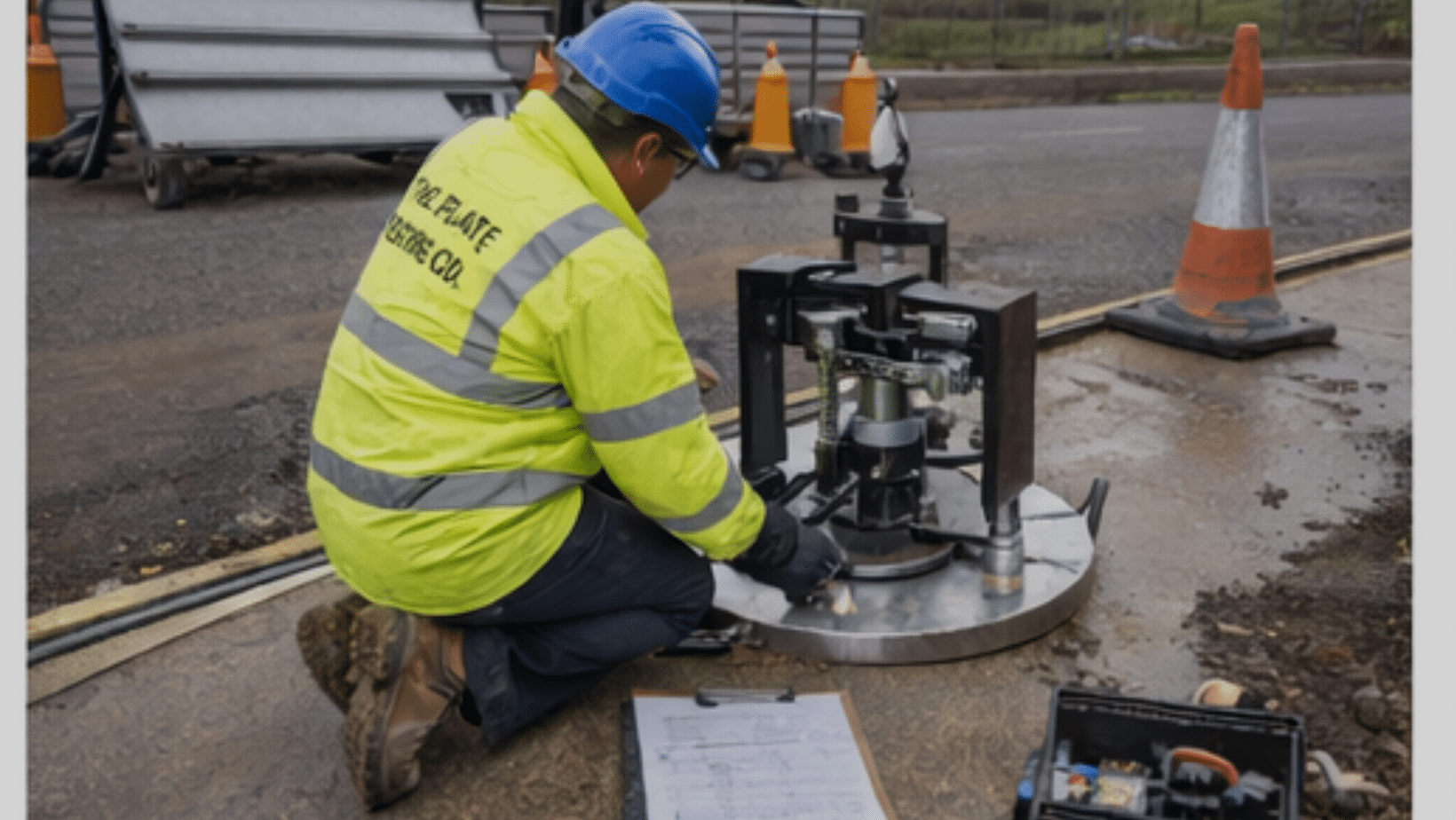
A circular steel plate (usually 300-600mm in diameter) is placed on the prepared surface.
A thin layer of sand may be added to ensure good contact.
- Reaction Load Setup
A heavy machine (like an excavator) acts as the reaction load (kentledge) to resist the applied force. (SOCOTEC UK)
- Load Application
A hydraulic jack applies load to the plate in small, incremental stages.
- Settlement Measurement
Dial gauges record how much the plate settles at each load stage.
- Load Increase
Load is gradually increased until:
- Settlement speeds up, or
- The required design load is reached
- Data Recording
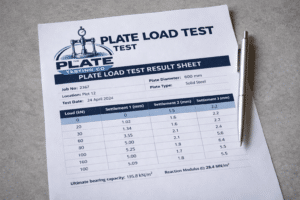
Results are plotted onto a load vs settlement curve, which is then used for analysis.
What Does a Plate Load Test Measure?
A plate load test gives you several critical engineering values:
Ultimate Bearing Capacity
The maximum pressure the ground can withstand.
This is calculated by dividing the load by the plate area.
Safe Bearing Capacity
The working load the ground can safely support, taking into account a factor of safety (typically 2.5-3). (STM Environmental)
Settlement Characteristics
How much the ground compresses under load.
Modulus of Subgrade Reaction (k-value)
A key parameter used in pavement and slab design.
Plate Load Test vs CBR Test
This is one of the most asked questions.
Plate Load Test
- Uses a large steel plate
- Measures bearing capacity and settlement
- Best for coarse soils and structural loading
CBR Test
- Uses a penetration piston
- Measures resistance to penetration
- Best for road design and fine subgrades
A plate load test is generally more representative of real-world loading conditions, especially for structural applications.
Interpreting Plate Load Test Results
Once the test is finished, the data is plotted onto a load-settlement curve.
Here’s what to look for:
- A smooth curve = stable ground
- Sudden increase in settlement = approaching failure
- Flat response = stiff ground
From this, engineers can determine:
- Bearing capacity
- Acceptable load limits
- Ground stiffness
This data is then used to inform foundation design and site safety decisions.
The Equipment Used in Plate Load Testing
A Standard Test Setup Includes:
- Steel bearing plates, with a diameter of 300 to 750mm
- A hydraulic jack to adjust the load
- A load cell or proving ring to accurately measure the pressure
- Dial gauges to record settlement readings in real time
- A reaction load, usually provided by an excavator or sufficient kentledge to hold the plate in place
All the equipment should be properly calibrated to give you accurate and reliable readings – you can’t afford to get this wrong.
Why Plate Load Testing Remains So Popular
Plate load testing is well liked for many good reasons:
- Its quick, it’s cheap, and it gets the job done
- You get real, on-site data that you can rely on
- It’s suitable for a wide variety of ground types, which makes it super versatile
- It’s relatively quick to set up, which means you can get on with the rest of your project
- And best of all, you usually get your results back within a few hours.
It’s one the most practical and reliable tests you can do in the field , and that’s why you see it being used so much.
The Limitations to Keep in Mind
Not every test is perfect, and this one is no exception
When you do a plate load test, just remember:
- It’s only really going to test the shallow ground layers, not anything deeper
- Your results might not be a perfect reflection of what’s going on below – it’s worth keeping that in mind
- You also need to be aware of scale effects – the plate you’re using isn’t the same size as the actual foundation
- And finally, you will need some heavy kit to provide the reaction load, so that’s something to factor into your plans
That said, when you use it right it’s actually a really reliable way to get the information you need for most construction projects.
following British Standards and Compliance
In the UK, you’ll usually find that plate load testing is carried out in line with:
- BS 1377 Part 9:1990 (In-situ tests) (SOCOTEC UK)
This standard gives you a clear idea of:
- What the test procedure is
- What kind of kit you need to use
- And how to make sense of the data you collect
By following the standard, you know that your results are going to be valid and accepted by engineers and the regulators.
Choosing A plate Load Testing Company
There’s no shortage of testing providers out there – but not all of them are created equal
When you’re looking for a company to do your testing, it’s worth keeping an eye out for:
- Machines that have been UKAS-calibrated – you can’t afford to risk inaccurate readings
- A fast turnaround time – you need to get the results back as soon as possible
- Reports that are clear and easy to understand – you shouldn’t need to be a genius to get the information from them
- Experience working with all sorts of different ground conditions – you don’t know what you’re going to get
- And finally, a company that can cover the whole country – you don’t want to be stuck with a firm that only works in one area
If you need reliable, on-site testing with results that you can rely on, you might want to have a look at what Plate Load Test Co have to offer
They specialise in fast, accurate plate load testing all over the UK , and they focus on getting you clear, site-ready reports that you can use to make informed decisions.
Common Mistakes to Avoid
If you want to get accurate results from your plate load test, there are a few things you need to avoid at all costs:
- Don’t skimp on ground preparation – a little bit of effort up front will save you a world of hassle down the line
- Make sure the plate is properly levelled and in the right place – a tiny bit of unevenness can throw the whole test off
- Don’t be in a rush to get the readings – you need to take your time and do it properly
- Don’t ignore the weather or the potential for moisture to affect the test – these are things that can really mess up the results
If you get one of these things wrong, you could end up with data that doesn’t make any sense – and that can lead to some very costly decisions.
Key Takeaways
- A plate load test is basically a way of finding out how well the ground can bear weight and how much it will settle
- It’s a crucial tool in foundation and platform design – you can’t start building without this information
- The results of the test are based on the real conditions on site – not on some hypothetical ideal
- It’s a fast, practical test that gets used a lot in the UK construction industry
- But, and it’s a big but, the test only works if it’s done right – you need to get the execution spot on and make sure you understand the results.
Frequently Asked Questions
How long does a plate load test take?
Most tests can be done in a matter of hours, and the results are often back the same day.
What size plate do you need?
That usually depends on the job, but it’s typically between 300 and 600mm.
Can you use the results for foundation design?
Yes – they’re often used to confirm or refine the design.
Is a plate load test better than a CBR test?
It depends on what you’re looking for. Plate load tests are best for structural loading, while CBR tests are used more for road construction.