

When you are planning a construction project, the stability of the ground beneath you is one of the biggest unknowns. You need to determine whether the soil will safely support a piling rig, crane pads, working platforms, or a permanent structure. Getting this wrong can lead to excessive settlement, damage to construction equipment, or serious programme delays.
Two common in situ tests are typically considered at this stage: the plate load test (also known as a plate bearing test) and the California Bearing Ratio (CBR) test. While both are used in site testing, they measure different ground properties and are suited to different ground conditions and civil engineering purposes.
Understanding how each test works and what the results actually tell you is essential for managing construction risk and ensuring your project’s success.
What Is a Plate Load Test?
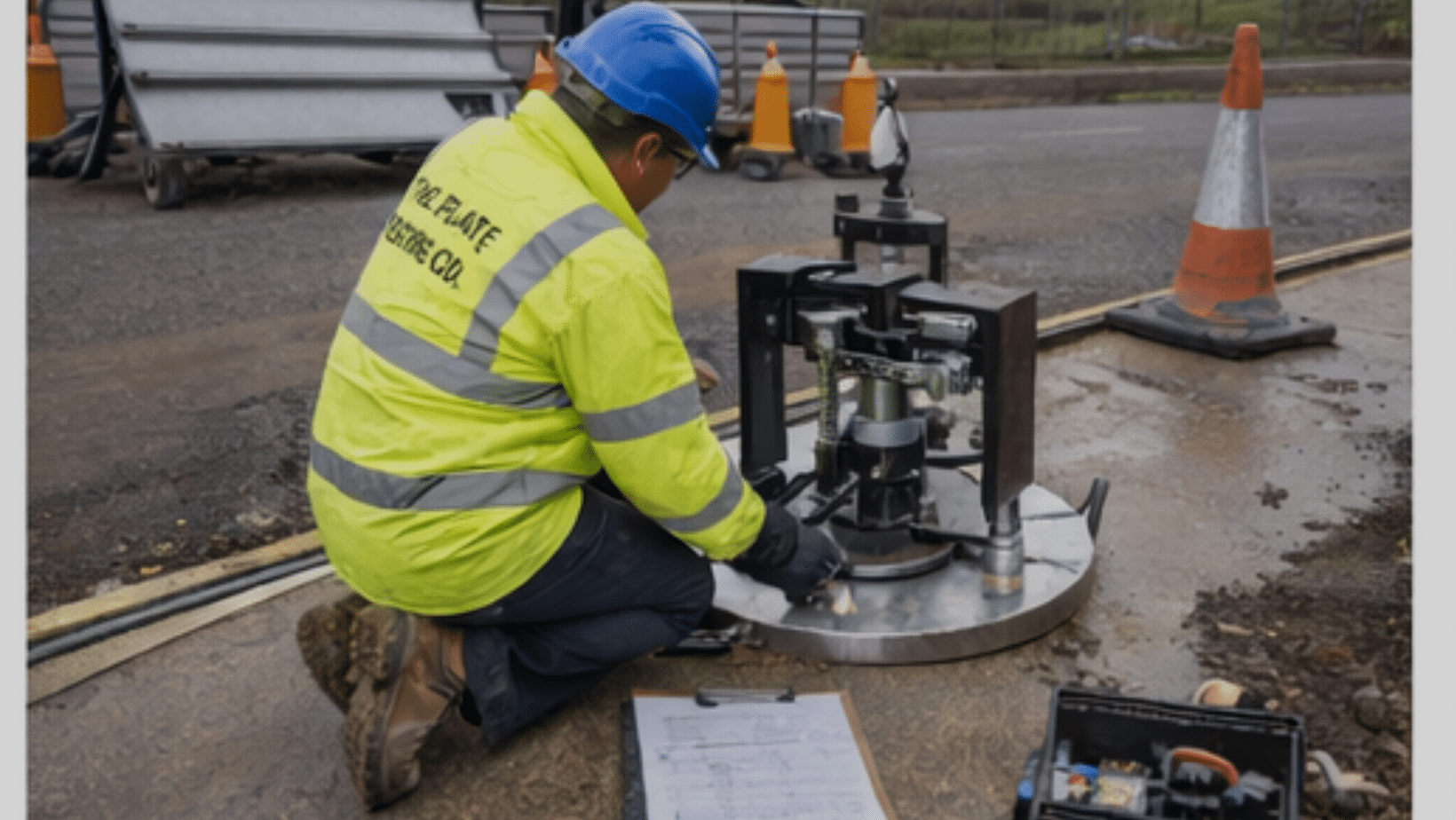
A plate load test is performed on-site to determine the ultimate bearing capacity and settlement behaviour of the ground at a specific test location. The test measures how the ground responds when a known load is applied through a rigid plate.
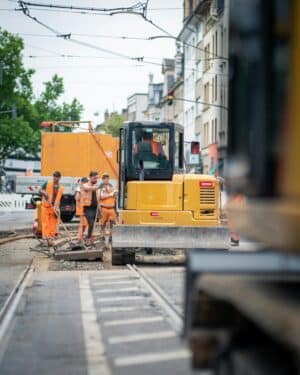
A circular steel plate or test plate of a known plate diameter and plate size (typically between 300mm and 750mm) is positioned on the ground surface or in a shallow pit at the proposed foundation level. Load is applied using a hydraulic jack, often reacting against heavy construction equipment such as a tracked excavator or kentledge to provide the necessary reaction load.
The load is applied in controlled load increments, and settlement is measured using dial gauges. As the increasing load is applied, engineers record how the plate settles. The test continues until the plate begins to settle rapidly and shear failure occurs, or until the required maximum applied load is reached.
What the Plate Load Test Measures
A plate load test directly measures:
- Ground bearing capacity and soil bearing capacity
- Ultimate bearing capacity and safe bearing capacity
- Settlement characteristics and load–settlement behaviour
- Subgrade reaction and strain modulus
- The actual strength of the ground beneath the plate
The ultimate bearing capacity is calculated by dividing the total load value required to induce settlement by the area of the steel plate. To determine the safe bearing capacity, this value is divided by a factor of safety, typically between 2.5 and 3, to limit the risk of failure under service loads.
Because the test is performed on site, it reflects real ground conditions, including ground particle sizes, compaction, and moisture, rather than relying solely on laboratory assumptions.
When to Choose a Plate Load Test
A plate load test is usually the preferred test method when:
- You need to verify working platforms for heavy plant
- The ground must support a piling rig, crane bases, or crane outriggers
- You are assessing temporary structures such as crane pads or piling mats
- The ground contains coarse or granular materials
- You need accurate and reliable data quickly to satisfy safety criteria
The test is particularly effective for granular layers, where smaller penetrative tests struggle to give consistent results. It is also commonly used for quality control of compacted layers and for verifying design assumptions before construction proceeds.
What Is a CBR Test?
The California Bearing Ratio (CBR) test measures the resistance of soil to penetration and expresses it as a percentage relative to a standard crushed rock material. A CBR value of 100% represents material equivalent to the reference stone, while low values indicate weak ground.
The CBR test uses a small plunger, typically around 50mm in diameter, which is pushed into the soil at a steady rate. Because it examines a relatively small area, it is best suited to fine-grained soils such as clays, silts, and sands, where material consistency is more uniform.
CBR testing is widely used for pavement design, roads, and slab foundations, where designers rely on CBR values to define layer thicknesses.
Limitations of the CBR Test
While the CBR test remains a standard approach, it has limitations:
- It examines a very small surface area
- Results can vary significantly on stony or coarse ground
- Large particles can distort readings
- It does not directly measure settlement under load
On sites with mixed or coarse materials, the CBR test may not accurately represent the capacity of the ground as a whole.
Real-World Comparison: Plate Load Test vs CBR Test
In practical terms, the difference between the two tests is how closely they represent real loading conditions.
A plate load test simulates how the ground behaves when a known load is applied across a wider area, making it more representative for foundations beneath structures, crane pads, and working platforms. The plate width spreadsthe load over a larger zone, reducing sensitivity to individual stones.
The CBR test, by contrast, is a penetrative test that focuses on material strength rather than load distribution and settlement response.
Speed, Practicality, and Results
Plate load tests are relatively cost-effective, quick to set up, and can often be completed at multiple locations in a single day. Results are typically available shortly after testing, allowing decisions to be made without delay.
CBR tests may require laboratory testing to achieve a reliable correlation, which can slow down programmes when time is critical.
Interpreting the Results
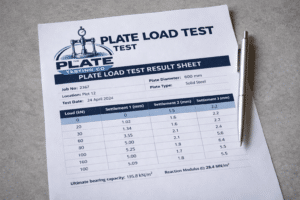
Plate load test results are usually presented as a load–settlement curve, showing how settlement increases as load rises. Engineers look for stable behaviour under the load required and check that settlement remains within acceptable limits.
CBR results are reported as a single percentage, which is useful for pavement design but less informative for assessing settlement under heavy loads.
In some cases, results from a plate load test can be used to calculate an equivalent CBR value, providing a familiar reference for designers while retaining the benefits of plate testing on coarse ground.
Which Test Do You Actually Need?
The choice depends on the question you need to answer:
- Will this ground support a crane or piling rig?
A plate bearing test is required to verify bearing pressure and settlement. - How thick should the road foundation be?
A CBR test or an equivalent CBR derived from plate testing may be appropriate. - Is my granular sub-base compacted and stable enough?
A plate load test provides the most reliable assessment.
Making the Right Decision
Selecting the correct test is a crucial step in reducing construction risk. Plate load tests play a crucial role in verifying that ground conditions match design assumptions and that structures can safely carry the intended load.
Used correctly, both tests provide valuable data. However, for heavy plants, temporary works, and coarse materials, the plate load test remains the most robust and representative method available.