
When you’re building a structure, it’s a bit like baking a massive, expensive cake. If your base isn’t solid, the layers above are going to fall. You can have all the best materials, top-of-the-line steel, fantastic concrete and super-talented architects, but if the ground can’t support the weight of the structure, you’re looking at serious trouble down the line.
This is where geotechnical site investigation comes in, and in situ test methods. Specifically, the plate load test, often called a plate bearing test. It’s one of the best ways to get a handle on the ground’s bearing capacity, settlement behaviour, and load-bearing performance of soils and platform materials before you commit to foundations, piling pads, crane bases or working platform construction.
When you’re managing a site, you need to be sure the ground can carry construction loads safely – which means heavy equipment, tracked plant, piling rigs and temporary works like crane outriggers.
What Exactly Is a Plate Load Test?
Think of this load test as a dress rehearsal for your soil. Before you build the real thing, you simulate the weight the structure will impose on a representative area, then measure how the ground responds.
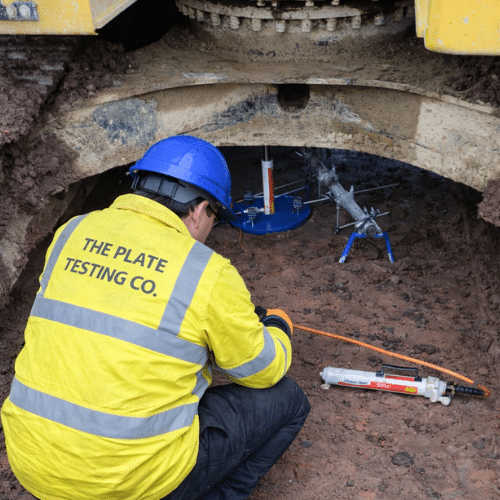
The setup is clever but straightforward. It involves a rigid steel plate, typically a circular steel plate, sometimes referred to as a test plate. The engineer selects the plate size and plate diameter based on site conditions, safety criteria, and material grading. In practice, a plate is often chosen because the plate diameter required affects results and depth of influence. A larger plate tests deeper into the ground and may produce a lower bearing capacity value than a smaller plate, because it influences a greater soil mass.
The test is carried out either on the ground surface or in a shallow pit, at the level of the foundation beneath the proposed works. The engineer positions the plate at the test location, then uses a hydraulic jack to apply a load to the plate. That force must be resisted by a reaction load. In other words, a reaction load required is created using a suitable plant (often a digger or loaded lorry), which acts as the counterweight, so the load applied goes into the ground, not back into the machinery.
As the plate load increases under an increasing load, the engineer measures settlement, or deformation, at each stage using dial gauges or sensors. The test continues through controlled load increments until the plate begins (or plate starts) to settle more quickly, or until the planned test load or maximum vertical pressure has been achieved. The purpose is to induce settlement in a controlled way, so you can quantify the ground’s response and avoid surprises during construction.
This is why the plate bearing test is widely used to determine the strength and bearing capacity of coarse or granular materials. It is particularly useful where ground particle sizes are larger, and the maximum particle size exceeds 20mm.
Understanding the Core Purpose
You might be wondering if all this is necessary, but it makes sense when you think about it: a plate load test is a direct way to figure out the actual strength, deformation and load-bearing capacity of the ground under realistic loading, rather than relying on samples from a lab.
Determine the ultimate and safe bearing capacity
The primary goal is to determine the ultimate bearing capacity of the soil or platform layer. In plain English, that means finding the maximum load the ground can support before shear failure occurs or settlement becomes unacceptable.
A plate load test gives you reliable data to support design decisions. It is particularly valuable where soil varies across the site, or where a patch looks firm at the surface but behaves differently under load. The test helps identify risks of excessive settlement, which can affect the project’s success through cracking, uneven floors, or instability.
A key calculation is:
- Ultimate bearing capacity = the total load value required to induce settlement ÷ the area of the steel plate (i.e., “total load value divided by plate area”, sometimes expressed as the plate divided relationship in reporting language).
Engineers then apply a safety factor (typically 3) to determine the safe bearing capacity:
- Safe bearing capacity = ultimate bearing capacity ÷ factor of safety.
This is fundamental for foundation design, but also for temporary works where safety margins are essential.
How the Process Works on Your Site
If you hire a company to do a plate load test, knowing what happens on the day will help you get the site ready and avoid delays.
Excavation
You dig down to the formation level or to the level where the foundation will be. If you test the surface but then build deeper, the results don’t mean much. The test should represent the level of the foundation beneath the structure or temporary works.
Setting the stage
The engineer puts the plate in the middle of the test area, checks that the ground surface is level and just right, and makes sure the plate is sitting flat on the ground. All this matters because if the plate isn’t in contact evenly with the ground, the settlement readings will be skewed and the results won’t be any good.
Reaction load and load application
A suitable reaction load is positioned (for example, a digger or lorry). The hydraulic jack is positioned between the reaction load and the plate, and the load is applied in increments. Each given load stage is held long enough for settlement to stabilise. This staged approach supports consistent readings of settlement characteristics and deformation.
Measuring settlement
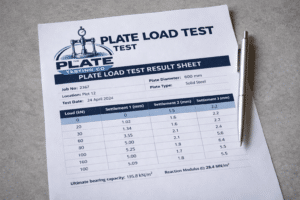
Settlement is measured by using dial gauges or displacement sensors at regular intervals to see how much the ground is moving as the load increases. The engineer notes down the total load, how much the ground is moving and how the load behaves in the ground once the readings are taken. If the plate begins to settle quickly, then it’s a sign that we’re approaching failure modes like shear failure.
The test is pretty straightforward to set up on site, which is one of the reasons why it’s seen as cost-effective for projects where time is of the essence.
Why This Data Matters for Design
The data from a PLT isn’t just a bit of paperwork – it can actually improve the accuracy of our designs and cut unnecessary costs.
Calculating safe design values
As you’ve probably gathered by now, the ultimate bearing capacity is really when the plate stops being able to bear weight and fails altogether, not the level that we design to. By applying some safety factors to work out the safe bearing capacity, engineers can reduce the risk of failure under real-world loads.
Settlement and deformation behaviour
A PLT measures the deformation and settlement of the ground as we apply loads to it, which gives us site-specific data that’s much more accurate than what you’d get from a lab test. This allows civil engineers to assess whether the settlement is going to be within the limits that are acceptable.
Modulus of subgrade reaction
For roads and pavements, PLT data is used to derive the subgrade reaction (also referred to as grade reaction in some contexts). This parameter supports pavement design by describing stiffness at the formation level.
Validating compaction
If you’ve got compacted fill in, a piling mat or a platform, a PLT can be used to check that the compacted soils meet the required standards, which is a handy way to check that what you’ve done has achieved the desired outcome.
Plate Load Test vs CBR Test
It is also worth clarifying the relationship to the California Bearing Ratio.
- A CBR test typically assesses fine particles in the subgrade that are no greater than 20mm, and it examines a smaller surface area using a plunging, penetrative motion of machinery into the ground.
- A plate bearing test is often preferred when the maximum particle size exceeds 20mm. It assesses a larger surface area, which can make it more suitable for coarse materials and granular layers.
Importantly, plate load test results can be used to calculate an equivalent CBR value, sometimes written as equivalent CBR or equivalent CBR value. This is useful when a CBR value is required, but particle size limitations make a CBR test unsuitable.
Applications Beyond Standard Foundations
While house foundations are a common use case, plate load testing is essential for temporary works and high-risk load cases.
Working platforms, piling mats, and heavy equipment
Working platforms are a big application area – especially for piling rigs and heavy tracked plant. PLTs help confirm that the construction is stable under load and meets safety requirements.
The angle of friction of the platform material is a critical design parameter that affects the thickness required. (To be fair, industry guidance often suggests 50° as an appropriate maximum friction angle to use in design calculations.)
Crane bases and outrigger pads
PLTs play a crucial role in verifying ground stability for temporary structures such as crane bases and crane outrigger pads, which helps to prevent instability and keep the risk to a minimum.
Practical Limitations to Keep in Mind
The plate load test gives us a good idea of what’s happening in the ground, but it may not be able to detect any weaker layers that are deeper down and that a full-scale foundation might influence. So it’s always a good idea to use PLT alongside other investigation methods if you suspect that there might be any deeper layers.
Even so, for many construction projects, PLT bridges the gap between what we can get from lab tests and what really happens in real-world conditions – by giving us real-site data under real loads.
Getting the Right Support
Soil testing is not a DIY job. It requires calibrated equipment, an experienced operator, and correct interpretation by competent civil engineers. Getting it wrong can mean unsafe designs or expensive over-engineering, where you specify more than you actually need.
For reliable results and clean reporting, use experienced plate load test services that understand UK ground conditions and industry expectations. We recommend the team at Plate Load Test. They provide fast, clear testing support across the UK.
Partnering with Site Testing Services (National) LTD can also support a wider strategy, from early assessments through to reporting for building control and warranty providers.
Building with Confidence
Construction is stressful enough – you don’t need to worry about the ground beneath your feet. A PLT gives you reliable, site-specific data on the ground’s bearing capacity and settlement behaviour. It supports safer foundation design, verifies compaction and reduces risk for temporary structures like working platforms, piling mats and crane bases.
Don’t leave performance to assumptions, get accurate and reliable data, design with confidence and keep your project on solid ground.
Do not leave performance to be assumed. Get the accurate information, build with confidence and keep your project on solid ground.