
Understanding the ground’s strength and bearing capacity is critical for any construction project. To do this accurately, engineers turn to different testing methods. Another common technique you’ll encounter is the CBR (California Bearing Ratio) test. Both have their place, but knowing the difference between CBR and plate bearing test methods is vital for choosing the right solution for your site and soil type.
Let’s break down the difference between CBR and plate bearing tests, from the procedures to the application. This way, you can make more informed decisions and ensure every building, road, or slab rests on solid ground.
What Is the Core Purpose of Each Testing Method?
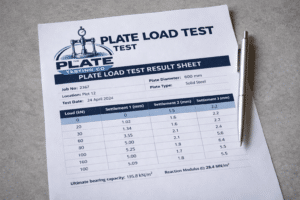
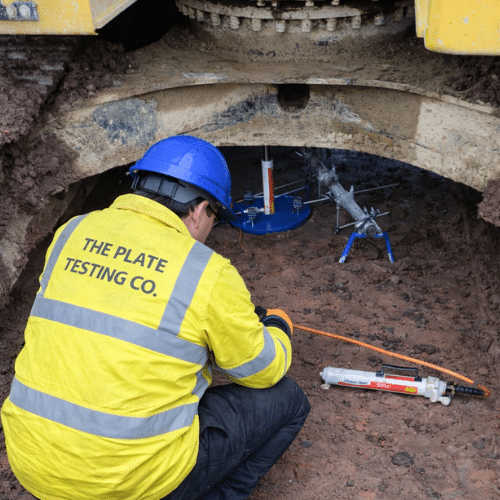
The plate bearing test is an on-site test that lets engineers figure out how strong the ground is and how much weight it can carry, right there on the surface. This is the best test for coarse materials and bigger particles; think gravel backfills, piling pads and crane mats. With a plate load test, you’re looking to apply an increasing load to a rigid steel plate, typically 300mm to 750mm in diameter, and it’s usually done using a hydraulic jack. The goal is to measure how much the ground beneath the plate settles under each new load and record any movement until the ground starts to fail or the plate starts to sink fast.
On the other hand, the CBR test (California bearing ratio test) is best for finer soils; think clay, silts or sub-base layers made from smaller aggregates. This test is mainly used for road and pavement design and can be done in a lab or as an on-site test. The test works by pushing a small plunger into a compacted soil sample or ground surface at a steady rate and measuring the load needed to do so. The result helps engineers figure out how thick the pavement and sub-base layers need to be to withstand traffic loads, all according to British Standard methods and highway design guides.
Plate Load Test vs. CBR Test: How Do They Work?
Plate Bearing Test: Load-Bearing Clarity for Structures
The plate bearing test directly assesses the strength and bearing capacity of the soil for foundations, concrete slab foundations, temporary structures, piling rigs, crane outriggers, and existing structures. Here’s how plate bearing test work is typically carried out:
- Excavate a shallow pit down to the level of the foundation or formation, making sure the test area is level and free of loose soil.
- Place the circular steel plate (steel plate size is critical; larger plates test a wider and deeper area) on the ground.
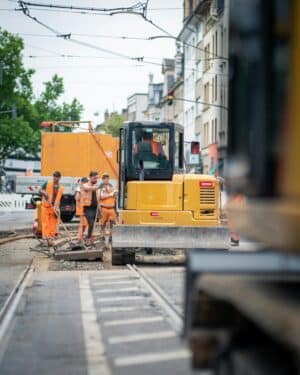
- Set up the hydraulic jack and reaction load: usually, a heavy excavator is piled right over the top of the plate.
- Apply load incrementally: the jack presses against the plate, and each new load is carefully measured and held. Accurate dial gauges record the plate’s settlement.
- Record and monitor settlement: as the load gets higher, the engineer notes the pressure required for any movement and when the plate starts to settle fast, which means shear failure or the ultimate bearing capacity has been reached.
The results will give you a load-settlement curve (to calculate safe bearing capacity using a safety factor) and modulus of subgrade reaction. The bigger plate area means the bearing capacity is integrated from a wider sample of soil particle sizes, making it perfect for coarse fill material, piling mats or foundations on engineered backfills. If needed, the results from the plate load test can be converted to an equivalent CBR value for comparative purposes.
CBR Test: Subgrades and Pavement Design
The CBR test (California bearing ratio, CBR) focuses on finer soils and subgrade reactions relevant for pavements, roads, and car parks. Here’s the step-by-step of a typical CBR test work:
- Prepare the ground surface or compact a cylindrical soil sample in a mould.
- Set up the reaction load and penetration plunger (usually 50mm diameter) atop the soil.
- Apply penetration at a constant rate: The plunger is forced into the soil at 1mm per minute.
- Measure penetration resistance: The total load required to push the plunger into specific depths (2.5mm and 5mm) is recorded.
- Calculate the CBR value: This is the ratio of the pressure required for the test soil to that required for a standard material, expressed as a percentage.
Unlike the plate bearing test, the CBR test has a much smaller area of influence and only looks at the strength and bearing capacity of fine, uniform soils, but it can’t reflect the behaviour of large particles or coarse material. British Standard and highway authorities frequently require the California bearing ratio test for sub-base and subgrade assessment.
Key Differences Summarised
| Feature | Plate Bearing Test | CBR Test |
|---|---|---|
| Primary Purpose | Determines the ultimate bearing capacity and settlement for foundations, platforms, piling rigs, crane pads, temporary structures, and ground-bearing slab foundations. | Determines subgrade strength for pavement and road design. |
| Result Given | Pressure value (kPa), load-settlement curve, safe bearing capacity, modulus of subgrade reaction, and equivalent CBR value if needed. | Percentage value (CBR%), indicating relative penetration resistance. |
| Equipment Used | Large steel plate, hydraulic jack, dial gauges, and reaction load (excavator). | Small plunger (50mm diameter), penetration machine. |
| Loading Type | Static, incremental loading measures settlement and total load. | Dynamic, constant-rate penetration; measures resistance to penetrative motion. |
| Materials Suited For | In situ test for coarser materials, large particle sizes, and engineered fills. | Fine soils and subgrades, particle sizes ≤ 20mm. |
| Area of Influence | Tests a larger area and depth (up to 2x plate diameter). | Small, localised test area beneath the plunger. |
| Standards/Use | Common for foundations, piling pads, working platforms, and crane outriggers. | Required for road foundations, pavements, and sub-base layers. |
Plate Load Test vs CBR Test: Which Should You Use?
- Use a plate load test when designing foundations, piling rigs, crane outriggers or ground-bearing slabs, especially where the soil is coarse, or you’re dealing with engineered backfills or piling mats. If you need to determine the ultimate bearing capacity or safe bearing capacity for a foundation or temporary structure, or you want to see how a ground surface or engineered fill behaves under heavy loads, a plate load test is a good option. It gives you real strength data and is often better than other testing methods.
- Use a CBR test (and consult CBR Testing) when designing or checking subgrade or pavement layers for roads and car parks, especially where the materials are fine and have smaller particle sizes. The CBR and plate tests are not interchangeable, and the right choice depends on the soil type and what you need to achieve: the CBR test is the standard for fine-grained soils and highway design, while the plate bearing test is better suited to coarse materials and foundations that are subject to higher pressures.
Summary: Choosing the Right Test for Your Project
While both plate load and CBR tests look at soil strength and bearing capacity, the applications and results are quite different:
- Plate load tests involve increasing the load on a circular steel plate using a hydraulic jack to determine how much a ground can bear for foundations, large structures, working platforms, and temporary construction loads. They’re great for in-situ testing of coarse soils, pilings and engineered backfills, especially when the load-bearing requirements are high.
- CBR tests calculate a CBR value by using a small plunger to push into the soil and measure how easily it penetrates. The CBR value is used as a design assumption for roads, pavements, and fine soils of uniform particle size.
Before you decide on a testing method, assess your soil sample and ground particle sizes first to ensure you’re doing what’s required by the British Standard. Plate load tests give you load-settlement data to help with design for ultimate bearing capacity and safe bearing capacity, while CBR tests help with determining thickness specifications for sub-base and subgrade materials in line with engineering standards.
Choosing the right test means your building materials and structures are founded on real strength data, not guesswork, giving you long-term safety and durability for your projects.