

The Plate Testing Co. is a specialist in providing plate bearing tests and plate load test services. These services deliver accurate and reliable data as part of detailed ground investigation works across the whole of the UK. All aimed at making sure your project is a success. We’ve been supporting civil engineering projects all over the country since 2016. We work closely with engineers, consultants, and construction companies to get a proper picture of just how much the ground can take. This is for all sorts of applications.
By applying a known load through a steel plate sitting on the ground surface or in a shallow hole, we can see how the ground behaves before it fails under the load or settles too much. We do all our testing to the recognised standards, BS 1377 Part 9:1990 and Eurocode 7. This is to make sure safe bearing capacity is properly accounted for.
Fast, Reliable Testing with Same-Day Results
Testing can be done on all sorts of soil types and ground conditions, piling mats, crane outrigger pads, foundations, working platforms, and temporary structures. Then use a reaction load, like a piling rig, a crane, or some other suitable plant, to give us the bigger reaction load we need to apply controlled pressure increments.
We apply each load increment through the loading plate and record the settlement at each stage. We use this to figure out just how much the ground can take before it starts moving too much.
Get in Touch
Request a free quote today and get fast, clear pricing for your testing requirements. Costs are competitively priced, with no location-based increases, as our engineers are available countrywide. Simply complete the form, and our team will respond promptly with clear pricing and availability.

Plate Load Testing / Plate Bearing Test Work
Our plate bearing test services assess ground bearing capacity by applying a known, increasing load through a circular steel plate positioned at foundation level. Using a hydraulic jack reacting against a suitable plant, we measure settlement under each load increment to determine ultimate bearing capacity and subgrade reaction.
This in situ method provides clear data on settlement characteristics, load-bearing performance, and safe bearing capacity for foundations, crane pads, piling mats, and working platforms. We record the results electronically on-site, allowing fast reporting and confident engineering decisions.
CBR Testing – California Bearing Ratio (CBR)
Our CBR test services assess soil strength using a plunger to apply a given load and measure the reaction load required. This produces a clear California Bearing Ratio value for use in pavement and sub-base design.
By correlating plate bearing data with CBR values, we often eliminate the need for additional testing, helping clients reduce duplication, improve cost efficiency, and accelerate project timelines.
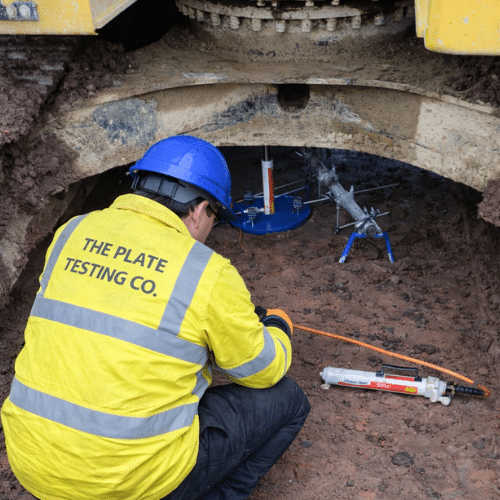
How Plate Bearing Test & CBR Testing Work
Setup and Plate Placement
We prepare the test location and, if required, excavate a shallow pit to foundation level. The correct plate diameter and plate size are selected based on ground particle sizes and design load requirements. The plate is carefully positioned on the ground surface to ensure even load distribution.
Load Application & Monitoring
Using a hydraulic jack, reacting against suitable plant or construction equipment, we apply incremental loads to induce settlement. Dial gauges and load cells monitor deformation characteristics, enabling precise assessment of sub-grade reaction and ultimate bearing capacity.
Data Collection & Analysis
The engineers record the total load, how much it’s settling, and the total value at each load increment. This lets us work out the maximum vertical pressure and confirm the safe bearing capacity for your civil engineering project.
CBR Testing
The CBR process applies a load through a plunger to measure how hard it is to push it in, showing us the soil strength for roads, crane pads, piling mats, and working platforms.
Why Choose The Plate Testing Co.?

Same-Day, Accurate, and Reliable Data
All plate bearing and plate loading tests are analysed electronically, providing immediate test results. You receive detailed load data, settlement graphs, subgrade reaction values, and confirmation of bearing capacity before our engineer leaves the site.

Nationwide Coverage & On-Site Flexibility
We cover civil engineering projects in all sorts of site conditions, from remote wind farms to complex city developments that need careful ground investigation.

UKAS-Calibrated Equipment & Experienced Team
Our equipment, including circular steel plates, calibrated load cells, and hydraulic jacks, ensures every test meets strict technical standards.
Ready for accurate and reliable plate testing and CBR testing?
Get in touch with The Plate Testing Co. today for same-day, on-site testing services. Ensure your site conditions, ground bearing capacity, and design load are right for any civil engineering project. Build with confidence; build on professionally tested ground.
The Advantages of Plate Testing
Quickly Verify Load-Bearing Capacity
To get a quick idea of the load-bearing capacity of your piling mats, crane pads, working platforms, and foundation-level installations before you put the major structural load on them.
Risk Mitigation & Quality Control
Validate the vertical pressure tolerances and stop any excessive settlement or shear failure before you bring in that heavy construction equipment.
Maximum Versatility
We can test a wide range of ground conditions, from big aggregate backfills to mixed soil types and complex ground conditions that need careful analysis.
Inform Foundation Design & Cost Efficiency
We make informed decisions based on reliable data regarding the ground bearing capacity and subgrade reaction characteristics of your test area, protecting your project’s success from day one.

Shaping The Future Of Construction
Frequently Asked Questions (FAQs)
A plate bearing test, also known as a plate load test, is an in-situ geotechnical field test used to determine the ultimate bearing capacity of soil (the maximum vertical pressure that can be applied before shear failure occurs), its settlement characteristics, and its stiffness (modulus of subgrade reaction). It works by applying a known, increasing load to a steel plate placed on the ground to simulate the pressure a real foundation would exert. The test is commonly used to assess the strength and capacity of large ground particles or coarse materials under foundation loads. This differs from the CBR test, which is typically used to evaluate the strength of finer subgrade particles no greater than 20mm in size.
Plate load tests require a level, prepared site with a circular steel plate (300 mm–750 mm diameter). Also, a hydraulic jack and a heavy reaction load (e.g., a 10-15 tonne excavator). We conduct our tests at the foundation level, using gauges to measure deformation, and follow standards like BS 1377-9:1990.
The main difference between a plate bearing test and a CBR test is the scale of testing and what they are designed to measure. A plate bearing test (PBT) uses a large steel plate. This is typically 300–750 mm in diameter. They use it to assess bearing capacity and the modulus of subgrade reaction for heavy foundations and structural loads. It evaluates the force applied, the amount of penetration, and the time taken for the rigid plate to settle under load. In contrast, a CBR test uses a small 50mm plunger to measure road subgrade strength. It primarily suits pavement design rather than foundation assessment.
A plate bearing test typically takes between 1 and 2 hours to complete. Most tests average around 1.5 to 2 hours. The exact duration depends on factors such as soil type, site conditions, and test setup. Also, on the number of load increments required. In some cases, tests can take as little as 45 minutes or extend up to 6 hours if ground conditions are more complex. Generally, we can complete 4 to 5 plate bearing tests during a standard working shift.
A plate bearing test is carried out by placing a rigid steel bearing plate, typically 300–600mm in diameter, onto a prepared, level area of ground at the test location. A hydraulic jack is positioned between the plate and a heavy reaction load. Such as an excavator, and the load is applied in controlled increments. Dial gauges are used to measure the amount of settlement that occurs under each load step. This allows engineers to record how the ground responds over time. Engineers calculate the capacity and settlement characteristics of the soil from this data.
News & Blogs
Latest Articles & Blog Posts
-
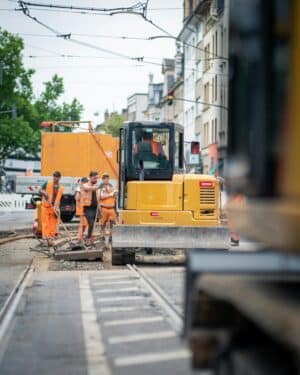
The Difference Between CBR and Plate Bearing Test
|
Understanding the ground’s strength and bearing capacity is critical for any construction project. To do…
-
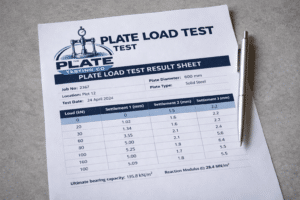
Understanding Plate Load Test for Bearing Capacity of Soil Reports
|
Once a plate load test for bearing capacity of soil has been done & dusted,…
-
Why Plate Load Test Is Done in Construction Projects
|
When you’re building a structure, it’s a bit like baking a massive, expensive cake. If…